
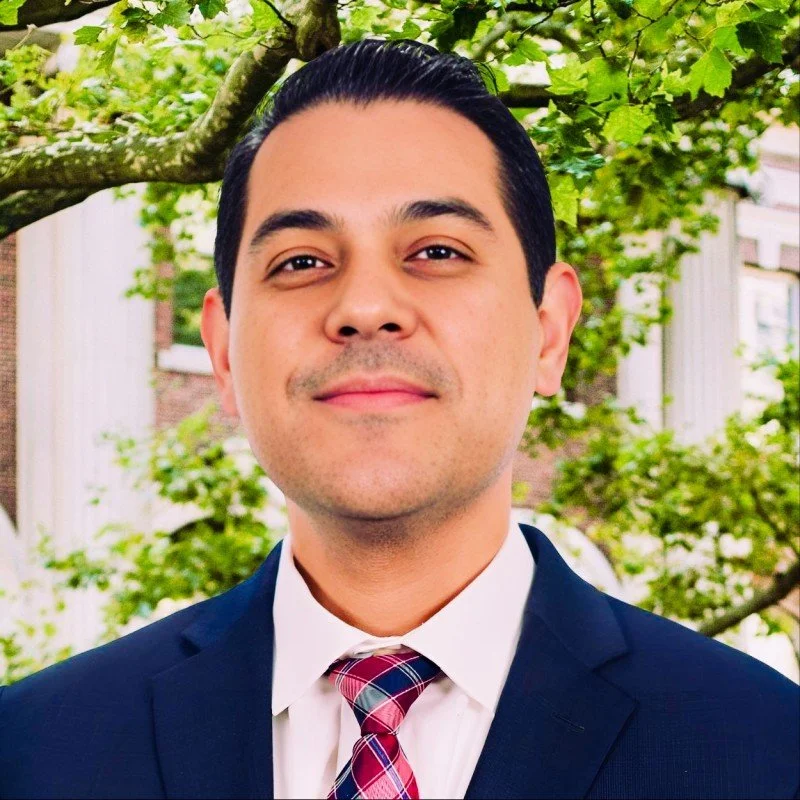
Celebrated Changemaker
The Courageous Kid From Compton Who Effectively Champions Every Child
Leadership is challenging, and we believe in celebrating those who excel. Each month, we invite you to join us in celebrating exceptional leaders who have achieved remarkable feats while collaborating with us at It's the Impact. Leadership can be isolating, and recognition is well-deserved. Please reach out to schedule a Discovery Session anytime.
This month, we celebrate Nolberto Delgadillo, Vice President of Strategy and School Finance at ExED, who has led finance and operations across multiple large urban school districts.
What does a CFO have to do with changing the world for kids?
If you're Nolberto Delgadillo, everything.
Nolberto currently serves as Vice President of Strategy and School Finance at ExED — but his career has been built leading finance and operations across multiple large urban school districts. On paper, that work lives in spreadsheets, budgets, and fiscal strategy. But beneath every title he’s held is a deeply personal mission: to change the conditions that determine whether students succeed.
Not just the students in the districts he serves, the students who look like the little boy he once was: an English-language learner growing up in a trailer park in Compton, California, ducking drive-bys on his way home from school, finding his footing in a world that wasn't built for him.
Nolberto carries that boy into every room he enters. And that changes everything.
The Change That Lives in the Margins
Most people don't think about finance when they think about educational equity. They think about teachers. Classrooms. Curricula. But Nolberto has spent a decade understanding something that not everyone sees: the decisions made in operations and finance rooms ripple directly into students' lives.
The tools schools have, the resources teachers can access, the processes that either open doors for kids or quietly close them — none of that happens without someone in a role like Nolberto's choosing to treat it as mission-critical work, not just administrative work.
What makes Nolberto exceptional is that he never lets the mechanics of his role obscure the reason for it. He thinks constantly about the adults he influences, the systems he shapes, and the students at the end of every decision. His work is proof that you don't have to be in a classroom to change what's possible for a child.
A ‘Why’ That Sits With Your Gut
The best leaders I know don't just have a mission statement. They have a story. And Nolberto's story is one of the most powerful I've encountered.
He grew up as the son of immigrant parents who arrived in the U.S. in the 1970s with very little. He qualified for free meals. He didn't begin speaking English until third grade. He witnessed gang violence — drive-bys on the walk home, a shootout during football practice. He was called names. He was underestimated.
And yet, the adults in his community showed up for him. They saw something in him that he was still learning to see in himself. Because of them, he made it to rooms that the boy from Compton wasn't supposed to reach.
Now, he brings that boy with him everywhere he goes.
"I like to think I use my leadership role to bring that voice to all those Nolberto’s from 40 years ago."
That is not a why you can manufacture or find in a leadership book. It's the kind of intrinsic motivation that outlasts hard days, political headwinds, and the seasons of work that feel invisible. It's what separates leaders who burn out from leaders who build legacies.
The Courage to Lean In
Here's something not everyone knows about Nolberto: he wasn't always someone who leaned in. For years — even as he built real skills and real experience — he held back. He didn't always trust that his perspective belonged at the table. He had the expertise, but something kept him from fully using his voice.
That changed when he did the internal work to understand not just what his role was, but why it mattered and who was counting on him to show up fully. Once that clicked, everything shifted.
This is one of the things I find most moving about working with leaders like Nolberto. Technical skills are rarely the thing standing between a good leader and a great one. It's the inner work: the clarity of purpose, the willingness to own your perspective, the decision to stop waiting for permission. Nolberto did that work. And the leaders, teams, and students around him are better for it.
Don’t Be a Martyr. Build a Coalition.
If there is one lesson from Nolberto's leadership that I want every changemaker to absorb, it's this: you cannot do this work alone — and trying to is not noble. It's a liability.
"Don't be a martyr. Focus on creating a coalition with others. Think about others who are aligned to the positive change you want to create. There's only so much span of control one has — how do you get past that and create a domino effect?"
He's not just talking about delegating tasks. He's talking about intentionally building a community of people around you who share your vision and can carry it further than you ever could alone. He also talks about this coalition as a gift to yourself — a protection against the kind of relentless self-sacrifice that quietly destroys the most dedicated leaders. Elite athletes study film and put in the hours, but they also rest and recover. Because none of it works if you're not present enough to lead.
This is countercultural in mission-driven spaces, where exhaustion is often mistaken for commitment. Nolberto names it clearly: sustainability isn't selfishness. It's strategy.
A Leadership Team Vs. a Team of Leaders
One of the distinctions Nolberto makes that has always stuck with me is the difference between a leadership team and a team of leaders.
A team of leaders is a collection of talented, motivated individuals. A leadership team is something far more intentional: a cohesive unit that moves together with shared purpose, clear roles, and genuine accountability to one another. One produces capable people. The other produces change.
Building that kind of team requires a specific kind of leader — one who starts not from, "What do I need from the people around me?" but from, "How can I help them succeed?"
That is Nolberto's default. Whether his team needs him to show up with direct, hands-on support or to step back and offer quiet counsel, he begins in the same place every time: How can I help?
His team knows it. His peers know it. And it's a large part of why people want to work with him, follow him, and fight alongside him for the work he believes in.
What Nolberto’s Story Teaches All of Us
Nolberto is not a headline-grabbing leader. He doesn't run a nonprofit born from personal tragedy or lead a movement that gets documented in films. His work happens in budget rooms and strategy sessions and one-on-one conversations with the adults who need him to show up well.
But the impact is just as real. And his story is a reminder that leadership doesn't have to look a certain way to matter.
Here's what I believe his journey most powerfully teaches:
Any role can be a mission-driven role. It's not about where you sit in an org chart. It's about whether you know why you're there.
Your lived experience is not a liability — it's your greatest leadership asset. The perspective Nolberto brings to every decision is shaped by everything he's lived. That's not incidental to his leadership. It is his leadership.
Sustainable change requires coalition, not martyrdom. Build the team. Protect your health. Lead for the long game.
Relationship-building is not networking. It's service. Start with "how can I help?" and build from there.
I am so grateful that leaders like Nolberto exist — and that he keeps showing up for this work, year after year, for kids who will never know his name but whose lives are better because of the decisions he makes every single day.
You could do a great many things with your talent, Nolberto. The fact that you spend it here means more than you know.
Find out how you can change lives too — schedule a Free Discovery Call.